

−76%annual hosting cost
Espresso Hub
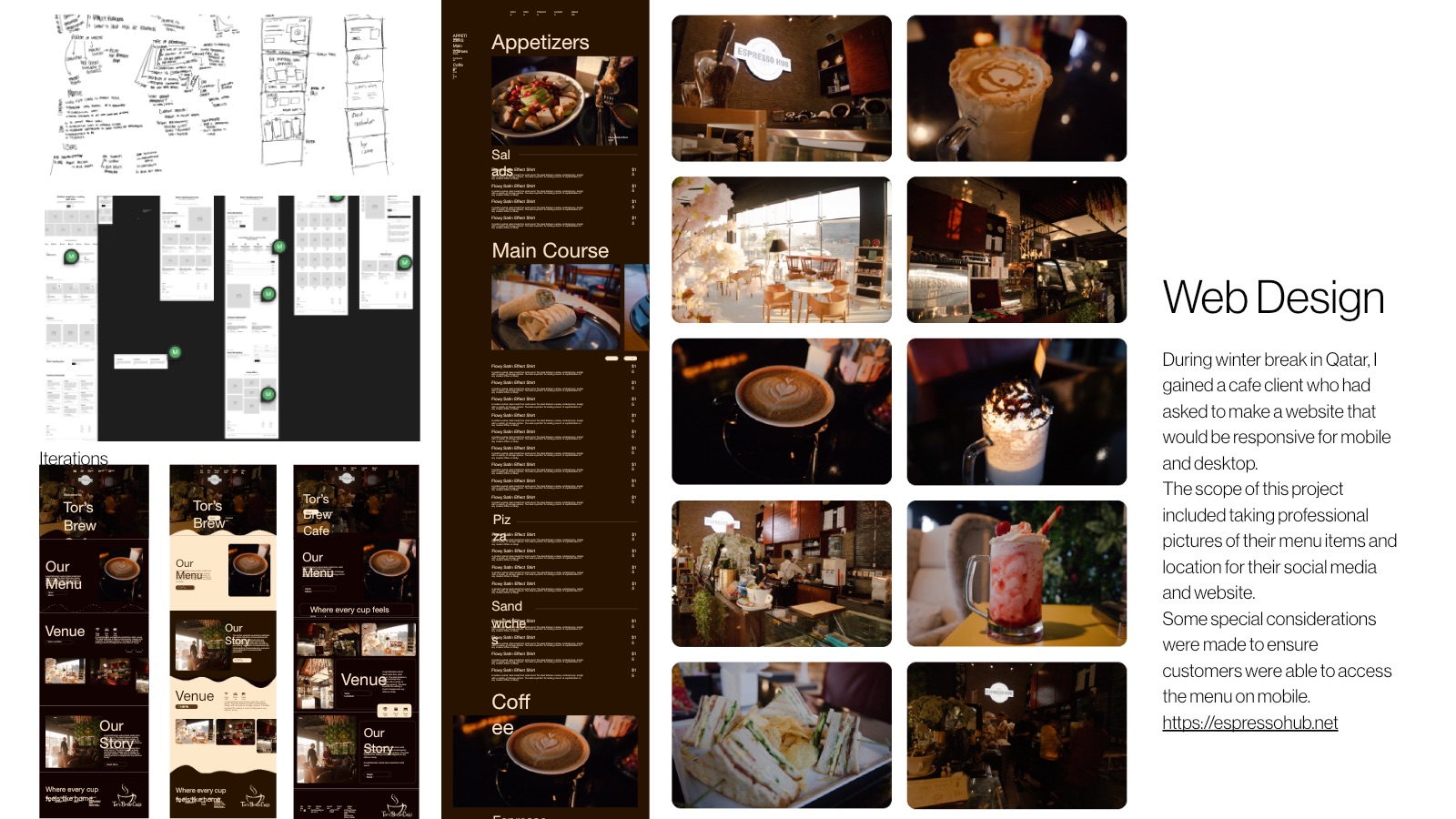
Designed a responsive website in Figma for a Doha café, also used as its in-store menu, and moved hosting to local servers with a developer.
QAR 2,100 → 500 a year; a QAR 1,000 order in launch week

Marie Françoise Cabibihan · UX Design, SCAD
View case studiesTwo team projects I led from discovery to delivery.
Case study 01 / 02
A roommate mediation app that gives college students a structured, low-friction way to share responsibilities and resolve conflict.
60–70% of college students experience roommate conflict, most often over cleanliness. Our research traced the cause to a lack of shared systems rather than bad intentions. Expectations are rarely set up front, accountability is informal, and students avoid raising issues for fear of damaging the relationship.
As product design manager on a five-person team, I defined the feature set and designed onboarding, the core chore flows, and the AI integration. In research, I co-led the competitive analysis of Cozi, Flatastic, Nipto, and Flatify and 12 student interviews using the Mom Test and GRAMS, then led the pain point analysis that set our design direction.
COHABIT is organized around three tabs (Chores, Inventory, and Group) and a five-step onboarding in which roommates agree to a shared contract before move-in. Habi, an AI assistant, runs across the app to handle reminders, task reassignment, and escalation.
Survey respondents asked for a clear system (29.1%) and accountability features (28.6%). Each chore is completed with a timed before-and-after photo, creating a shared record that removes ambiguity about who did what.
Photo proof for every chore
Habi sends reminders, reassigns tasks, and escalates in tiers, so no roommate has to confront another directly. When peer mediation isn't enough, a one-time code gives the RA time-limited access to the full history, with no recap required.
Time-limited RA access
A heuristic evaluation with Prof. BC Hwang surfaced ten issues, led by visual inconsistency, missing feedback after photo capture, and unclear retake controls. We rebuilt the design system and micro-interactions, and the app's rating rose from 4.4 to 4.6.
Rating 4.4 → 4.6
How might we…cultivate motivation and communication in an accessible way to encourage accountability and consistently prevent problems that occur in shared living spaces?
In the second round of usability testing, likelihood to use the app frequently rose from 76% to 84%, and likelihood to recommend rose from 82% to 87%. I was the only first-year UX student selected to submit the project to The Rookies.
Testers pointed to two opportunities: deeper gamification and a stronger role for Habi as the product's emotional anchor.
Case study 02 / 02
An opt-in kiosk and Microsoft Teams and Slack plugin that help employees discover, create, and join workplace events.
One in five employees feels lonely at work every day, and workplace loneliness costs companies $154 billion a year in lost productivity. Social events are the default fix, but invites get buried in email, employees struggle to find the room, and mandatory gatherings reduce psychological safety.
As project manager, I set timelines and deliverables and coordinated the research, branding, marketing, and design workstreams. I also defined the UX strategy and led user research.
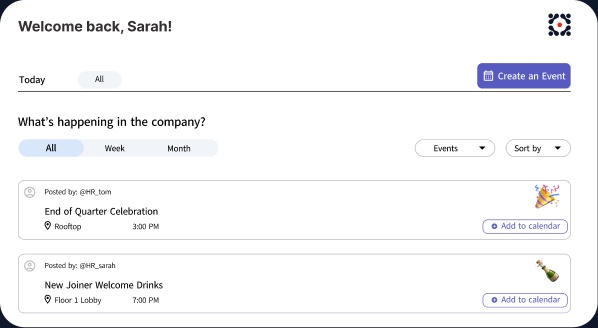
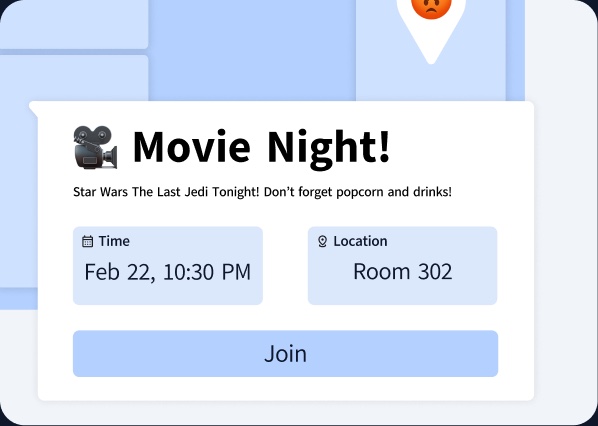
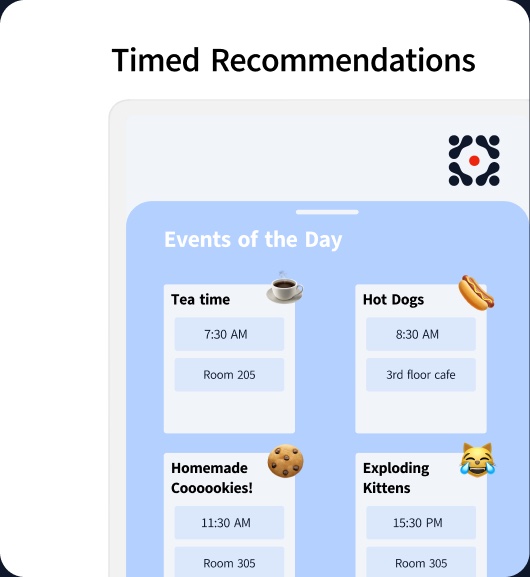
A kiosk placed by lifts and entrances maps what's happening on each floor, and a plugin for Microsoft Teams, Slack, and Outlook lets anyone create, find, and add events to their calendar.
We took the concept from research to MVP in one week and pitched it at the SCAD StartUp Competition to a venture capitalist and designers from OpenAI, Meta, Adobe, and YouTube.
Requiring a download would repeat the pressure employees already resist. A kiosk is part of the space, so people can engage while they wait or move between floors, or simply walk past.
No download required
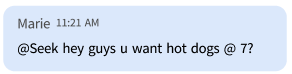
New enterprise software can take months to approve, so a plugin for the tools employees already use lowers the barrier to adoption. Its bot can detect an event in a Teams message, such as "I brought pizza," and offer to post it.
Teams · Slack · Outlook
Mandatory gatherings reduce psychological safety. SEEK surfaces what's happening nearby and leaves the decision to join with the employee.
Always optional
Interactive prototype. Click through the SEEK kiosk. Open in Figma
A conceptual MVP, prototyped in two days of a one-week sprint.
The same events, inside the tool employees already have open. Open in a new tab
Startup, client, and research projects, with the results they produced.
Co-built TrendAds, an AI ad generator that turns live trends into ready-to-post campaigns. I designed its 6-step guided flow and positioned it against competitors including Canva and AdCreative.ai.
Presented at R42 Demo Day
Designed a responsive website in Figma for a Doha café, also used as its in-store menu, and moved hosting to local servers with a developer.
QAR 2,100 → 500 a year; a QAR 1,000 order in launch week
Created promotional materials, photography, and a logo animation shown at the International Conference on Social Robotics. Taught CAD, programming, and robot building to grades 4–6.
+10% event attendance
Joined in the final phase of an industry-sponsored project, got up to speed on the brief and its constraints, and worked through unclear requirements with designers from other disciplines to deliver an internal campaign.
Delivered for a financial regulator on a shortened timeline
Segmented users by learning frequency and motivation, rewrote emails without guilt-based messaging, and designed an A/B test of tone and frequency.
Projected a lift of at least 5% in DAU engagement and fewer opt-outs
Interviewed students testing the startup's WhatsApp MVP (25 members across 6 habit communities) using the GRAMS framework, and returned to 9 of them after 3–5 weeks of use.
Turned the findings into 2 personas and a behavior model with the founder
Redesigned the bus tracking flow so riders can read arrival times at a glance, and added early arrival alerts.
Clearer arrival times across every route
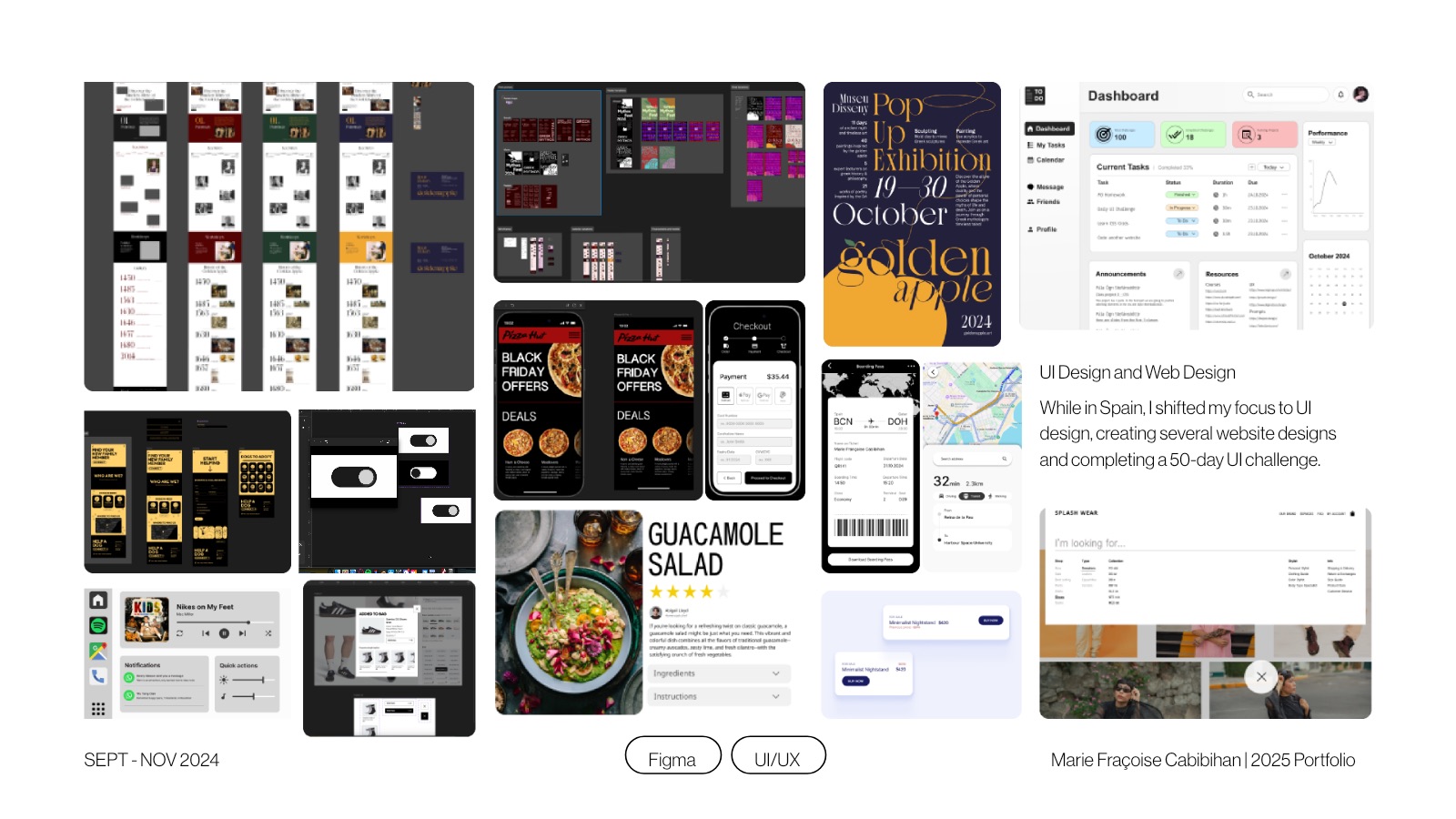
Motion, 3D, and interface explorations from coursework and a 50-day UI challenge.
I turn user research into clear product decisions.
Before SCAD, I studied interaction design at Harbour Space University, with coursework in consumer behavior, content strategy, email marketing, branding, 3D and motion design, and front-end development.
I've led two five-person teams as product design manager and project manager, owning timelines, scope, and research while designing core flows. My motion minor shapes how I present work, often as short animated walkthroughs.
User interviews, surveys, segmentation, GRAMS framework, usability testing, heuristic evaluation
Feature scoping, Agile sprints, team leadership, A/B test design, AI-enabled product concepts
Figma, prototyping, responsive design, design systems
After Effects, Blender, DaVinci Resolve
HTML, CSS, JavaScript, SwiftUI